
History
A Specific Need
In September 2018, a first contact was made with two highly motivated teachers who wanted to open an independent, unsubsidized private school. Their project was bold, modern and well advanced. They benefited from substantial financial support from a foundation owned by a very wealthy Québec philanthropist. The goal was to open a school in September 2019 for students from the end of elementary school through both cycles of secondary school — a school built around the involvement of people from a range of professional fields, preparing students to thrive in a modern society.
A series of meetings took place to support them in developing their project, so they could open their school as planned at the start of the 2019–2020 school year.
In discussions with these teachers, one need kept coming up: to better support their students throughout their schooling. They needed a tool that would make it possible to follow the progression and consolidation of learning.
Conceptual Development
The Cogitare mockup was developed between January 11 and February 6, 2019, to better understand how the portfolio would work. Developing such an ambitious project would require major investment. Several meetings were held with the team of teachers involved. Then, at the end of March 2019, the teachers withdrew, and funding that had seemed promising fell through.
The portfolio project was put on ice.
In February 2020, more than a year later, a meeting was arranged to present the project to Rafael Scapin, a professor at Dawson College, to see whether there was interest in involving students enrolled in a computer science program. He referred us to Jaya Nilakantan, then head of the Computer Science department. Then COVID arrived, and the project was put on ice once again.
Pause and Rebirth
After a six-year hiatus due first to professional demands and then to personal constraints, the project of building a dynamic digital portfolio came back to life on April 1, 2026 — this time using three AIs to go from a mockup to a working web application.
Cogitare was finally going to become a viable application.
We did, however, face constraints that ultimately turned into a functional advantage. We submitted the mockup to Google's Gemini AI, which quickly grasped the concept and delivered a first version with the basic elements working. This AI was important for initial development, but after a few weeks it could no longer keep up with the growing complexity of the interface's features.
On May 14, 2026, we chose to continue development with Claude AI, which met our needs much better. On Tuesday, May 26, 2026, the Cogitare dynamic digital portfolio was made available for experimental use with learners in Secondary Cycle Two.
The portfolio was advanced enough to launch phase 3 of its development.
The Future… Is Already Here!
Cogitare is a transmedia product. Data is stored in the cloud, and the interface is built to run on a PostgreSQL database. Learners access their portfolio through single-code authentication. Our portfolio already runs on a range of devices (tablets and Chromebooks, as well as computers) and across operating systems (Windows, macOS, Linux, Chrome OS and iOS).
An artificial intelligence module was added to guide students through Socratic reasoning — offering questions that push them to surpass themselves, never answers.
A lightweight PWA for iPhone and Android phones is also available, making it possible to capture the moment as it happens.
Evolution of the Portfolio
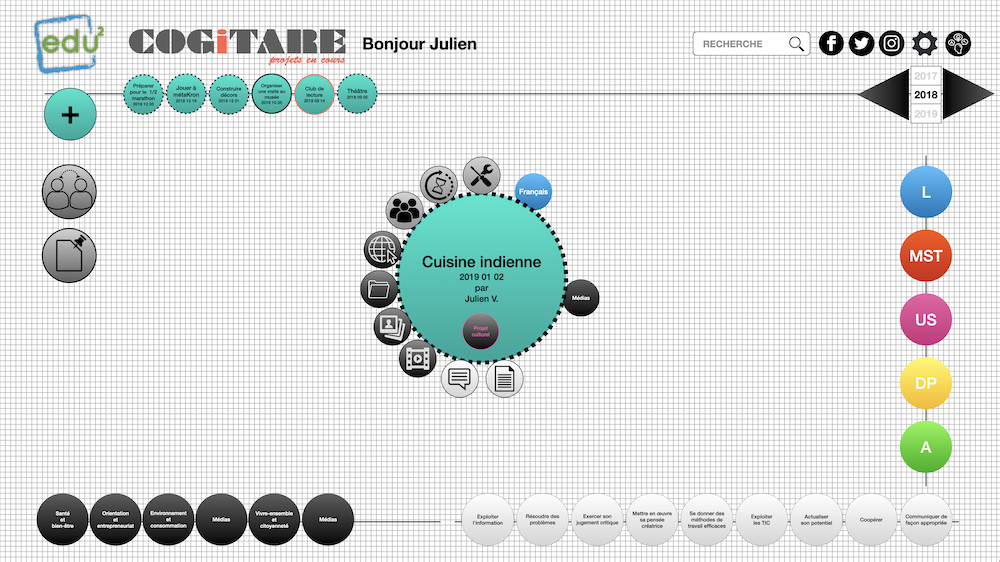
2019 Mockup
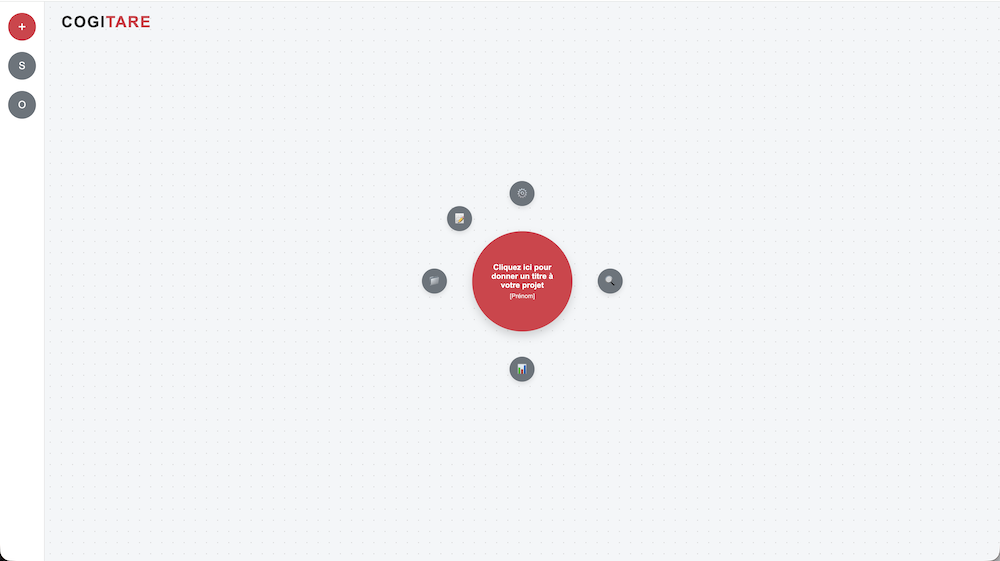
Gemini AI writes 174 lines of code on April 26, 2026
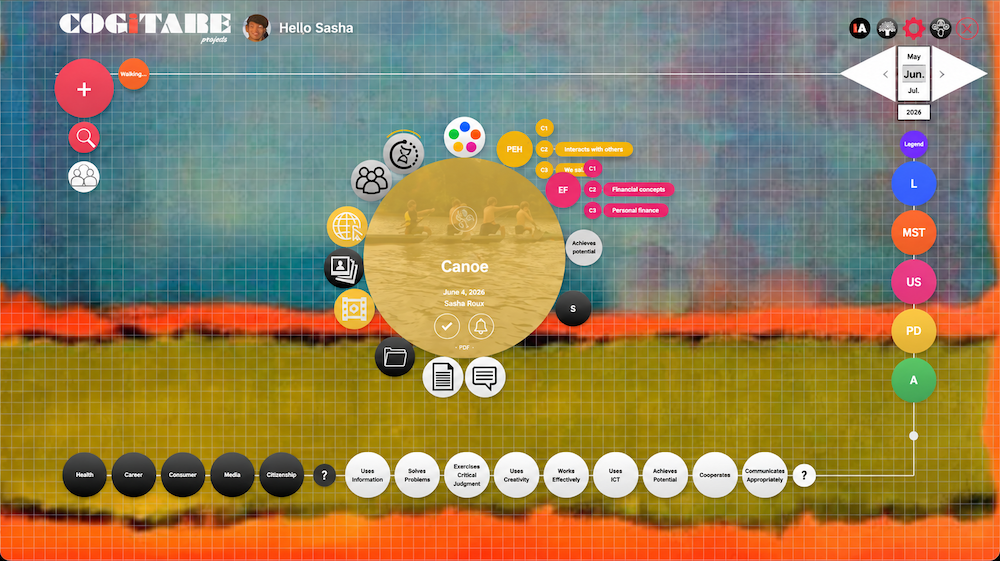
As of August 26, 2026, Claude AI had written 6,041 lines of code for the Projects module
The Cogitare portfolio was designed, developed and produced by André Roux
in collaboration with Gwenola De Grimaudet, Hugo Turgeon-Côté and Arnaud Lemazurier,
as well as Johanne Proulx and Élyse Dion, educational consultants, Julie Poulin and Sylvie Rouleau, teachers,
Julie Provencher, assessment specialist, Florian Meyer, professor at Université de Sherbrooke,
Stéphane Allaire, professor at Université du Québec à Chicoutimi,
Guy Brodeur, free thinker and AI developer, and Yves Otis, educational technology consultant…
using ChatGPT for quick information searches,
Gemini for light coding,
and Claude for more advanced coding.
Thanks to David Fredette of VisionInfo for hosting.
I thank Simon Emmanuel Roux for encouraging me to switch to Claude,
an AI suited to the complexity of this project.